
HAVIT PB5203 vs PB5217 vs PB5228 vs PB5219 Magnetic Power Banks

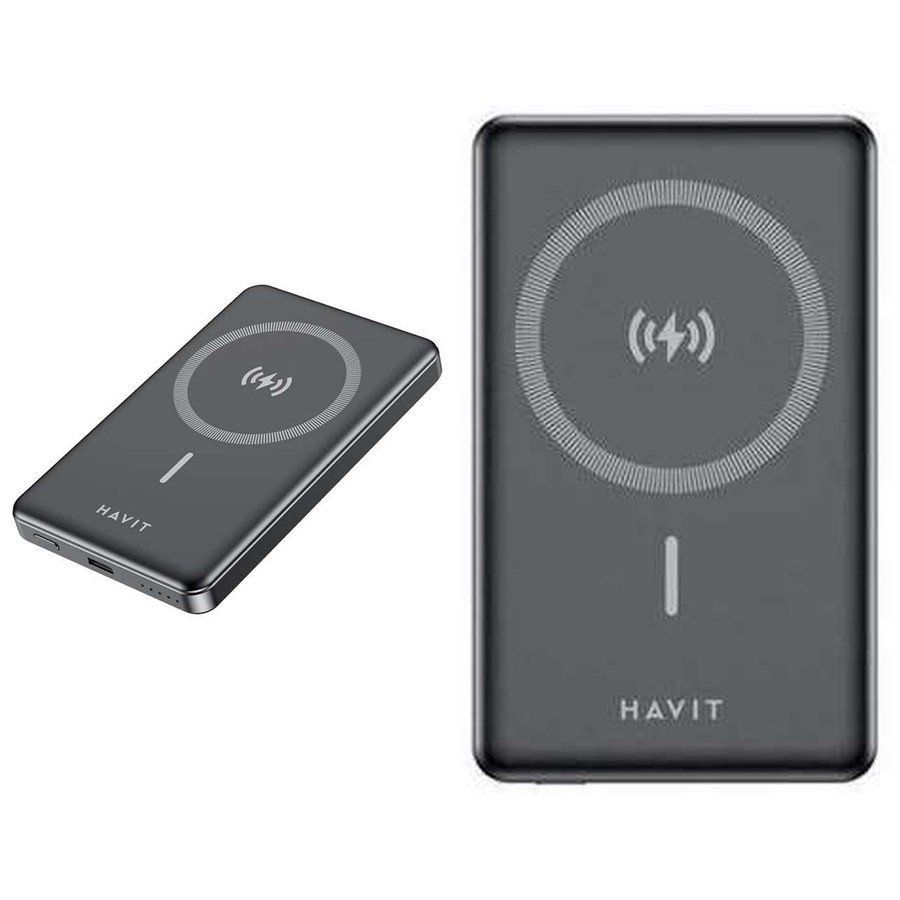
Not every magnetic HAVIT power bank has the same phone, smartwatch and earbuds charging features. The November 2026 supplier sheet describes PB5203, PB5217, PB5228 and PB5219 as 10,000mAh-class accessories with 20W-class wired outputs, but the body materials, charging-position options and marketing descriptions differ. For a Kenyan shopper, the key question is which device and charging standard the power bank will actually support, not whether a magnet happens to hold a phone. This is a supplier-specification comparison with current WooCommerce prices, not an independent certification or charging-speed test.
Four current HAVIT magnetic and wireless power banks
- HAVIT PB5203 — KSh 2,995: 10,000mAh; magnetic/wireless output advertised to 15W; USB-C PD20W; aluminium-alloy case; 190g.
- HAVIT PB5217 — KSh 3,295: 10,000mAh / 37Wh; magnetic 15W wireless output; 20W USB-C; black or white; approximately 197g.
- HAVIT PB5228 — KSh 3,495: 10,000mAh / 36.5Wh; advertised N52 magnets; 15W wireless and 20W USB-C; aluminium-and-glass case; 198g.
- HAVIT PB5219 — KSh 3,595: 10,000mAh / 37Wh; wireless phone output up to 15W plus watch/earbuds pad marked 2.5W; 20W USB-C; approximately 200g.
Why magnetic alignment and wireless charging are two separate things
A magnetic ring can help position a compatible phone, but magnet strength does not establish a charging protocol. The phone must contain appropriate wireless charging hardware and align with the transmitter coil. The supplier advertises up to 15W wireless output for all four models under supported conditions, but it does not verify the exact charging rate for every iPhone, Android device, case or magnetic accessory. Don’t present the N52 magnet designation on PB5228 as proof of Apple MagSafe or Qi2 certification: those are separate product-standard claims that require certification evidence.
PB5203 versus PB5217: similar idea, different finishing
PB5203 has an aluminium-alloy shell and a listed mass of 190g, while PB5217 is described as aluminium alloy plus silicone and about 197g. Both have 10,000mAh capacities, 15W supplier wireless claims and 20W USB-C PD output. The manufacturer excerpt gives PB5217’s energy as 37Wh but does not provide identical battery-cell test data for the pair. The small weight difference is unlikely to decide performance; grip, magnetic alignment, phone-case compatibility and actual temperature are more important.
PB5228: magnetic-grade and glass-style design
PB5228 explicitly lists N52 magnets, an aluminium-and-glass body and a titanium colour. Its 36.5Wh energy figure is slightly different from the 37Wh quoted for other 10,000mAh models. That is a specification difference, not proof of a material real-world battery advantage or disadvantage. Glass-finish products may need more care against impact and scratches, but the supplier row does not provide common drop-test or scratch-resistance results.
PB5219: the additional watch/earbuds charging position
PB5219 adds a supplier-listed 2.5W wireless position for a watch or earbuds alongside a 15W phone wireless charger and 20W wired USB-C output. That sounds useful for someone who carries several gadgets, but smartwatch charging is often proprietary. The phrase “watch/earbuds” does not prove every Apple Watch, Samsung Watch or earbud case supports this transmitter. Confirm the exact watch model, charging contact style and operating position before paying. It is also not established whether all outputs can operate at their individual maximum simultaneously.
Can a 10,000mAh bank fully charge a modern phone twice?
A power bank’s milliamp-hour figure is usually based on internal cell voltage; the phone receives power at a converted output voltage. Conversion losses, battery-management overhead, wireless heating and active phone use reduce energy delivered. For that reason, a printed 10,000mAh battery is not a reliable promise of two full charges for every phone. The supplier lists around 36.5–37Wh for most models in this group; even that energy figure should be considered before losses. A wired USB-C connection is generally preferable when efficiency or heat matters, subject to device compatibility.
Safe everyday use
- Check the phone genuinely supports wireless charging; a magnetic case alone cannot add the receiving hardware.
- Remove metal accessories and incompatible credit cards from between charging surfaces.
- Use a safe compatible USB-C charger for topping up the bank; its 18W input limit differs from a 20W output claim.
- Allow airflow around the phone and power bank instead of enclosing them in a hot bag while charging.
- Stop immediately if the bank becomes swollen, leaks, emits an unusual smell or overheats abnormally.
Which model makes sense?
Consider PB5203 for an aluminium-shell magnetic option at the lowest current price; PB5217 for the described silicone-and-aluminium finish; PB5228 if you specifically value the listed N52 magnet and case design; PB5219 only when the additional compatible watch/earbuds charging station is a real need. None is established as faster for every phone without testing the exact device.
Frequently asked questions
Does 15W wireless mean every iPhone charges at 15W?
No. Device negotiation, certification, temperature, alignment and case compatibility may limit the rate.
Will PB5219 charge any smartwatch?
No. The supplier lists a watch charging function but not universal proprietary watch protocol support.
Is a magnetic power bank the same as MagSafe-certified?
No. Magnetic positioning is not proof of certification or guaranteed 15W performance.
Shop HAVIT power banks in Nairobi
Use the four model links above, read the HAVIT power bank buying guide, or explore the HAVIT Kenya hub. Infinite Tech is at Rehema House, Standard Street, First Floor Shop 2, Nairobi CBD; call 0720 450 148 to verify actual phone compatibility, available colours and physical stock. Current WooCommerce retail prices are final.
Source: November 2026 HAVIT supplier catalogue, page 2, and live WooCommerce models PB5203, PB5217, PB5228 and PB5219. No independent certification or charging test.
