
Hisense Air Conditioner Outdoor Unit Placement in Kenya: Ventilation and Service Clearance

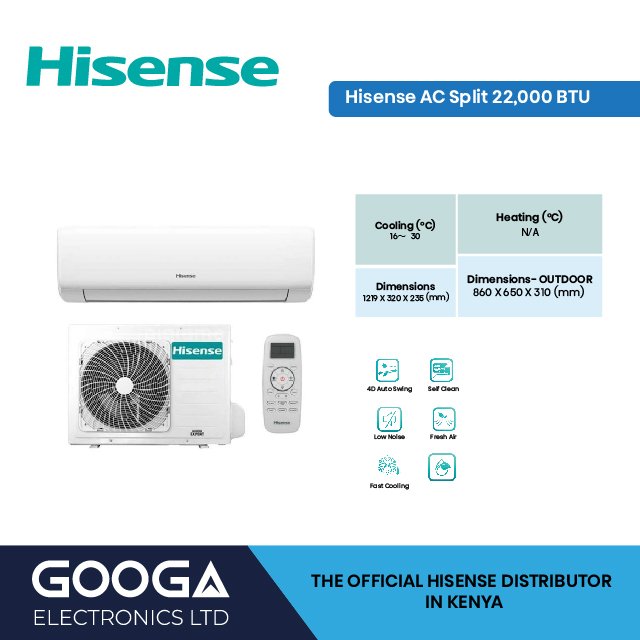
The location of a split air conditioner’s outdoor unit affects airflow, noise, maintenance access and the quality of the installation. A unit squeezed into a narrow shaft, boxed into a balcony or placed where hot exhaust air recirculates may struggle to reject heat. For a Hisense air conditioner, the exact spacing and mounting requirements must come from the installation manual for the model supplied. This guide explains the site-planning questions to settle before an installer drills walls or mounts brackets in a Kenyan home, apartment, shop or office.
1. Give the outdoor unit room to move air
The outdoor heat exchanger needs an unobstructed path for air intake and discharge. Do not hide the unit inside a sealed cabinet, close-fitting enclosure or decorative box without a manufacturer-approved ventilation design. A confined location can cause hot air to circulate back through the coil, reducing heat rejection and potentially triggering protective operation. Avoid placing the discharge directly toward another outdoor unit’s intake.
2. Follow the exact model’s clearance diagram
There is no single safe clearance measurement for every Hisense split, floor-standing, ducted or cassette system. The required rear, side, front and overhead spaces depend on the unit design and installation manual. Ask the installer to identify the model number on the indoor and outdoor units and show the relevant clearance diagram before fixing the brackets. Do not copy spacing from a different capacity or product family.
3. Consider shade without blocking ventilation
Direct afternoon sun can heat the outdoor casing and surrounding surfaces, but a shade structure must not obstruct the fan or coil. A roof or canopy should be designed with the manufacturer’s required open space and safe access. Do not wrap the unit in fabric, plastic or a close-fitting cover while it is operating. If a canopy is proposed, have the installer confirm that it will not redirect hot discharge air back toward the coil.
4. Plan condensate and rainwater drainage
Split systems produce condensate at the indoor unit, and installation arrangements may include drainage from the outdoor section depending on climate and model. The installer should plan a continuous drain route with appropriate fall, secure connections and a safe discharge point. Water must not run onto electrical equipment, walkways, neighbouring property or a wall where it can cause staining and dampness. Do not assume the outdoor unit’s position alone solves indoor condensate drainage.
5. Use a stable mounting surface
Wall brackets, concrete plinths and floor stands must be appropriate for the outdoor unit’s weight and the building structure. The unit should be level as directed by the manual, securely fixed and supported with suitable vibration-control components where specified. Avoid thin, loose, corroded or cracked supports. In apartments, confirm building-management rules before drilling external walls or placing equipment on a shared balcony.
6. Think about noise and vibration
Place the unit away from bedroom windows, quiet study areas and neighbouring sleeping spaces where practical. A rigid wall can transmit vibration into a room even when the unit itself is operating normally. Ask the installer to check bracket stiffness, fasteners, pipe contact and anti-vibration provisions. Do not place the unit where its normal fan noise is directed into a neighbour’s window or a narrow echoing corridor.
7. Preserve safe service access
Technicians need room to inspect electrical connections, valves, pipework and the heat exchanger. A location that requires climbing over a parapet, leaning outside an unsafe balcony or dismantling a permanent enclosure is poor planning. Provide a safe access route and enough working space as specified by the manufacturer and local building requirements. Do not create a maintenance hazard to gain a few centimetres of floor space.
8. Check pipe routes and electrical supply before installation
Confirm the permitted refrigerant-pipe length, height difference, insulation, flare or connection method and any additional charge requirements for the exact model. These values are model-specific. The electrical circuit, protective device, isolator and earthing must also comply with the manufacturer’s instructions and applicable electrical requirements. Do not accept improvised wiring, unsupported exposed pipework or a drain hose that discharges onto a walkway.
Outdoor-unit site checklist
- Confirm the exact Hisense indoor and outdoor model numbers.
- Review the correct manufacturer’s installation diagram and clearances.
- Check intake and discharge airflow, including possible hot-air recirculation.
- Confirm shade or weather protection does not enclose the unit.
- Plan condensate drainage and prevent nuisance water discharge.
- Verify the wall, bracket or plinth can safely carry the equipment.
- Consider vibration, noise and neighbouring properties.
- Provide safe technician access for cleaning and servicing.
- Confirm pipe length, height difference, wiring and isolator requirements.
- Obtain a written installation quotation that lists included materials and commissioning checks.
Related Hisense air-conditioning guides
Before selecting capacity, read the Hisense AC heat-load planning guide. For installation quotations, compare the AC installation cost checklist. If you are comparing system formats, see the portable versus wall-split AC guide.
Frequently asked questions
Can I put a Hisense outdoor unit in a small balcony?
Only if the exact installation manual’s clearances, airflow, drainage, mounting and service-access requirements can all be met. A narrow enclosed balcony may be unsuitable.
Can I cover the outdoor unit to hide it?
Do not use a close-fitting cover while the air conditioner is operating. Any screen or canopy must preserve the specified airflow and access.
Does the outdoor unit need direct sunlight?
No. The key requirements are ventilation, safe weather exposure, structural support and the manufacturer’s installation conditions. Shade must not block airflow.
Can the outdoor unit sit on a bedroom wall?
It may be possible, but consider transmitted vibration, noise, mounting strength and service access. Ask the installer to assess the wall and location.
Are clearance measurements the same for every Hisense AC?
No. Use the installation manual for the exact indoor and outdoor model. Do not assume a measurement from another unit applies.
Who should install the refrigerant pipework and electrical supply?
Use a qualified air-conditioning installer and electrician as appropriate. Do not attempt refrigerant or mains electrical work yourself.
What should an installation quotation include?
It should identify the model, pipework, brackets or stand, drain route, electrical work, wall penetrations, commissioning checks, warranty and exclusions.
How often should the outdoor coil be cleaned?
Follow the model manual and local operating conditions. Dust, leaves and blocked airflow should be addressed safely by a qualified technician when access is difficult.
Compare a current Hisense split AC listing
Infinite Tech lists the Hisense AS-22CR4SBBTG01 22,000 BTU split air conditioner. Use the exact indoor and outdoor model labels and the manufacturer’s installation documentation for final clearances, pipe limits and electrical requirements. The product listing is a starting point for model identification; confirm current stock, price, warranty and installation scope before purchase.
Installation note: This is a planning checklist, not a substitute for the model’s installation manual. Final positioning, electrical work, refrigerant piping and commissioning should be completed by qualified personnel.
