
HAVIT Power Bank Recharging Slowly or Showing Wrong Percentage? Fixes

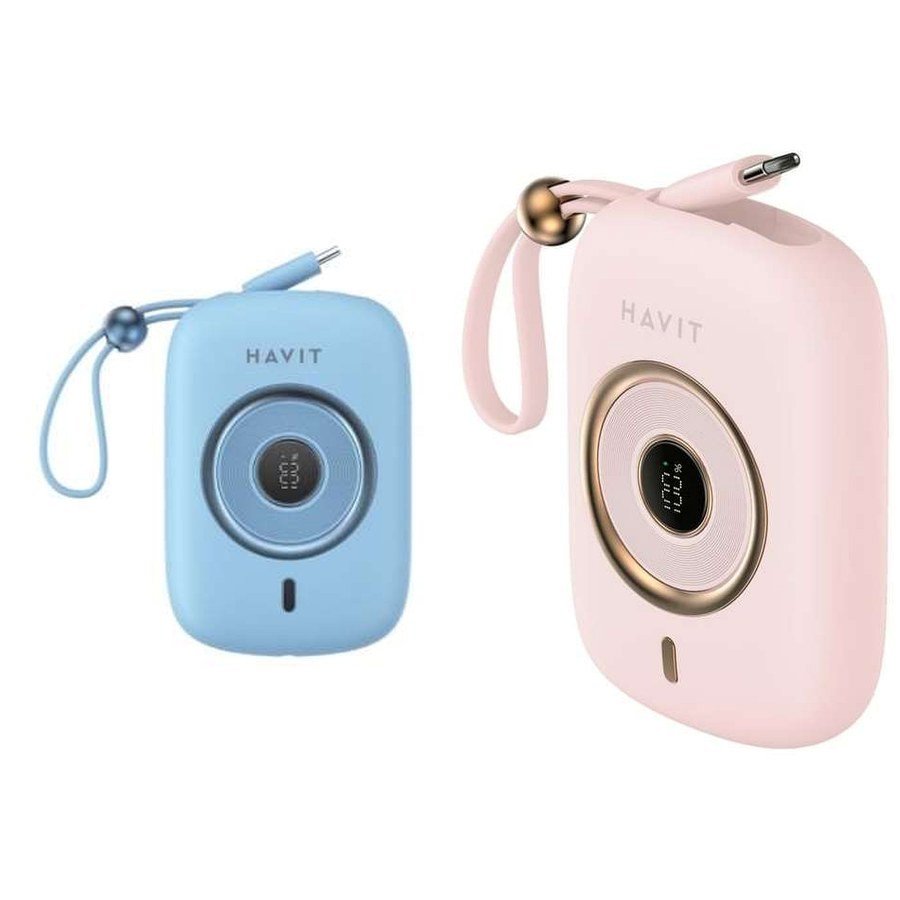
A HAVIT power bank that recharges slowly, displays an unexpected battery percentage or stops at a particular number isn’t necessarily faulty. The input side of a power bank is different from the output used to charge a phone: a product advertised to deliver 35W, 65W or 100W to a compatible device may accept a lower rate when recharging itself. The November 2026 HAVIT catalogue lists different input and output profiles for PB5214, PB5212, PB37 and PB5224. This guide explains how to inspect those limits, the cable and battery indicators without opening a lithium battery or inventing a universal calibration process.
1. Confirm which number refers to input power
PB5214 has supplier-described USB-C PD output up to 35W; PB37 advertises up to 65W output; and the high-capacity PB5212 has a separate larger power-output claim. Those output maximums do not establish the maximum power the bank accepts from a wall charger. Find the exact Input specification on the physical product or manufacturer sheet. If the charger supplies less than the rated input, or the protocols do not match, recharge time will be longer than a headline best-case estimate.
2. Use the correct USB-C port and cable
Some multi-port power banks have ports that can both accept and deliver power; others designate separate input and output connections. Check the exact port symbols and model manual instead of guessing from the USB-C shape. Use a known-good cable rated for the supported current and a suitable legitimate wall charger. A poor connection, damaged plug or power-only USB port may prevent full power negotiation. Never attempt to bypass the battery-management circuitry using improvised wires or high-voltage adapters.
3. Recharge time rises near full capacity
Lithium battery charging commonly has a faster early phase and a slower final phase as the cell approaches its full safe voltage. The percentage may rise quickly from low levels but linger near the top. That is not automatically evidence of a false capacity. Charging speed can also fall when the battery is warm, very cold, aged or balancing internally. Compare behavior under ordinary dry room conditions and the manufacturer’s normal charger requirements rather than leaving the bank charging indefinitely in an enclosed bag.
4. What if the number jumps from 70% to 50%?
Digital percentage displays are estimates made by battery-management electronics. Their behavior depends on voltage, load, temperature and the device’s method for estimating capacity. A sudden change can occur after a high-current phone connection or when the bank rests, but repeated extreme jumps or an early shutdown may indicate a battery fault. The price list doesn’t provide a model-specific recalibration sequence for the PB family; do not apply repeated deep-discharge cycles as a supposed universal fix. Deep discharge can stress lithium batteries.
5. Separate remaining capacity from charging speed
A nominal 10,000mAh or 20,000mAh figure is generally based on internal cell conditions. The energy reaching a phone at a converted USB voltage is lower after conversion losses, cable losses and wireless heat. A phone consuming electricity while charging further reduces the net battery-percentage gain. Therefore, “my 10,000mAh bank did not charge a 5,000mAh phone twice” is not sufficient by itself to establish fraud or failure. Use watt-hours where available and the exact manufacturer’s efficiency data to set expectations.
6. Multiple devices change power sharing
Power banks with USB-A and USB-C outputs may provide different per-port rates when several devices are connected. The PB37 and PB5212 are different power-class products, so do not transfer one model’s simultaneous output chart to the other. If your own bank charges slowly while also powering a phone, disconnect the external loads and observe recharging behavior alone, provided the exact manual supports that operation. Some units restrict input and output at the same time or handle pass-through differently.
7. Safety signs that matter more than the display
Stop using or charging any power bank that swells, cracks, leaks, smells chemically unusual or produces abnormal heat. Do not puncture the battery, open a sealed unit or try to restore it using a makeshift power supply. Keep it away from direct sun, a hot vehicle interior and combustible fabric. If a charging cable is damaged or the power bank has been dropped hard, inspect it and seek professional service before resuming normal use.
8. Document the fault for the seller
Record the model, input label, wall charger and cable used, starting percentage, whether other devices were attached, ambient conditions and how the display changed. Comparing the same setup over a normal safe session helps separate a poor cable from an internal fault. If the unit still repeatedly fails with the correct input, consult the seller rather than continuing unsafe tests. This guide does not assert a particular warranty term.
Frequently asked questions
Why does a 100W power bank take hours to recharge?
Output wattage is not the same as input charging power; capacity, charging profile and temperature determine recharge time.
Should I drain a lithium power bank to zero to calibrate it?
Not without specific manufacturer guidance. Repeated deep discharge can be harmful.
Why does a percentage display change under a heavy load?
Estimated state of charge can respond to voltage sag, temperature and load, but extreme recurring jumps warrant inspection.
Read the PB5212 versus PB37 comparison, the phone-not-charging fault guide and the HAVIT Kenya hub. Infinite Tech: Rehema House, Standard Street, First Floor Shop 2, Nairobi CBD; 0720 450 148.
Model source: HAVIT November 2026 power-bank supplier catalogue. General battery behavior is explanatory; no universal calibration method, claimed replacement guarantee or independent efficiency test is provided.
