
HAVIT PB5224 vs PB5215 vs PB5214 vs PB35: Which Power Bank in Kenya?

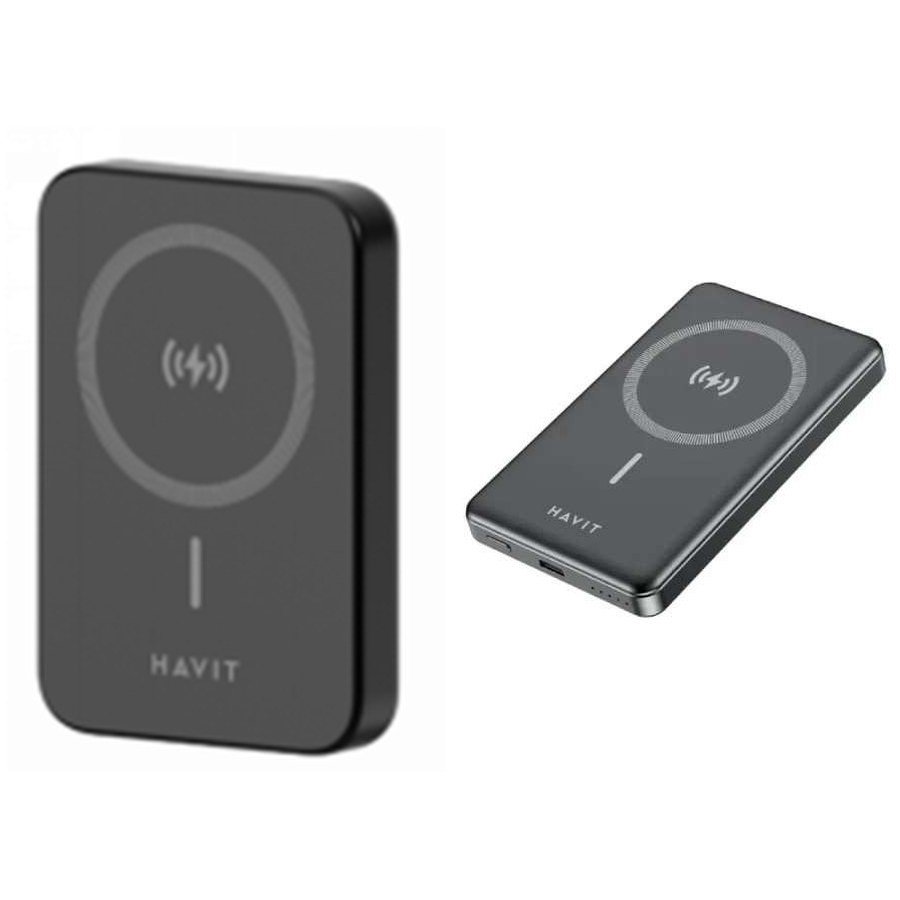
Four HAVIT power banks can have similar retail prices while solving very different charging problems. The November 2026 catalogue includes a 10,000mAh wireless model (PB5224), a 10,000mAh model with built-in cables (PB5215), a 10,000mAh USB-C Power Delivery model rated up to 35W (PB5214) and a 20,000mAh wired model (PB35). Comparing only battery capacity or the biggest wattage figure can lead to an unsuitable purchase, particularly when charging USB-C laptops, newer iPhones or several devices together. Here is a model-specific buyer comparison using the supplier sheet and current Infinite Tech WooCommerce prices.
Four HAVIT power banks compared in Kenya
| Feature | PB5224 | PB5215 | PB5214 | PB35 |
|---|---|---|---|---|
| WooCommerce retail price checked | KSh 2,495 | KSh 2,495 | KSh 2,895 | KSh 2,945 |
| Supplier-listed battery | 10,000mAh / 37Wh | 10,000mAh | 10,000mAh / 37Wh | 20,000mAh / 77Wh |
| Main convenience | Magnetic/wireless charging described | Built-in USB-C and Lightning cables, LED percentage display | USB-C PD/PPS up to 35W | Built-in USB-C cable and larger energy capacity |
| Wireless charging | Up to 15W stated; device-dependent | Not listed | Not listed | Not listed |
| Wired power claim | USB-C PD 20W | Up to 20W / 22.5W supplier wording | USB-C PD 35W, PPS mentioned | USB-C PD20W; built-in cable up to 22.5W |
| Specified weight | 181g ±5g | Not stated in row | Not stated in row | 332g ±10g |
Values above are from the distributor catalogue. WooCommerce listing prices change over time, so each product link should be treated as the final current retail source.
PB5224: wireless convenience for a compatible phone
HAVIT PB5224 is listed with a 15W wireless output and compatibility levels including 10W, 7.5W and 5W, plus a 20W USB-C PD output. Wireless charging sounds convenient on a desk or during brief breaks, but not every phone negotiates the same speed, and a magnetic attachment claim does not establish Apple MagSafe certification or Qi2 certification. Check whether your exact phone requires a magnetic-compatible case or alignment accessory, and verify its charging profile. Wireless charging typically creates more heat and conversion losses than an optimized cable setup; avoid covering the phone or power bank during operation.
PB5215: the model for people who forget cables
HAVIT PB5215 is sold with supplier-described integrated Type-C and Lightning cables and a percentage-style LED battery indicator. The catalogue says it can charge up to three devices depending on port and cable configuration. A built-in Lightning connector can be particularly convenient for an older Lightning-equipped iPhone, while USB-C supports other compatible phones. The cable connector alone does not prove a specific fast-charge protocol or compatibility with every device. Also, charging multiple devices may share the total output power, so the individual device rates may be lower than a headline maximum.
PB5214: choose it for a documented 35W USB-C PD profile
HAVIT PB5214 lists output profiles including 20V/1.75A, giving a theoretical 35W USB-C Power Delivery maximum on the stated port. It also names PPS charging profiles. This may be useful for compatible fast-charging phones and some low-power USB-C devices, but do not claim it will charge every laptop. Laptop requirements vary: some need 45W, 65W or higher, and they may refuse low-power sources or only charge slowly while sleeping. Check the laptop’s USB-C PD specifications, the cable’s current rating and the power bank’s ability to sustain the requested voltage before purchasing.
PB35: larger energy capacity for longer travel days
HAVIT PB35 lists 20,000mAh at 3.85V, or 77Wh, with a built-in USB-C cable. It has a claimed 20W USB-C PD output and up to 22.5W via the built-in cable or USB-A under specific profiles. At around 332g, it is notably heavier than the 181g wireless PB5224. A 20,000mAh rating is not a promise that any particular phone can be charged twice or four times: real delivered energy is reduced by conversion inefficiency, cable losses, phone battery condition, temperature and the phone’s use during charging. Think in terms of the stated 77Wh capacity rather than marketing charging-count guarantees.
Why mAh and charging watts are different
Milliamp-hours (mAh) describe an electrical charge at a stated battery voltage, whereas watt-hours (Wh) describe stored energy. The printed figure of 10,000mAh on a power bank is normally measured at internal cell voltage, not at the 5V, 9V or 20V output. Watts (W) describe the instantaneous rate of electrical power: higher output does not necessarily mean greater total battery capacity. A 35W bank may finish a suitable short charging task faster than a 20W bank but hold less energy than a 20,000mAh model. On multi-port chargers, total output limits may be lower than the sum of per-port headline maxima.
Practical buying decisions for Kenyan customers
- For wireless desk charging: check PB5224, confirming the phone’s own wireless profile and alignment requirements.
- For a bag with fewer loose cables: compare PB5215 with the type of connector your phone uses.
- For documented 35W USB-C PD: examine PB5214 and the charging protocol required by your device.
- For longer periods away from outlets: consider PB35 for its 77Wh supplier-listed energy, accounting for the heavier carry weight.
Frequently asked questions
Does every 15W wireless power bank charge an iPhone at 15W?
No. The actual charging rate depends on device standards, certification, alignment, firmware, case and thermal conditions. The catalogue alone does not guarantee the maximum for a specific phone.
Will PB5214 fast-charge a 65W laptop?
A 35W maximum does not meet a 65W input rating. Some compatible computers may accept lower power under limited conditions, but that must be confirmed from the exact laptop’s manual.
Is the PB35 battery permitted on flights?
The printed 77Wh capacity may fall within common airline carry-on power-bank limits, but airline and aviation-authority policies can change. Check the carrier’s current restrictions, terminal protection rules and whether spare lithium batteries must remain in hand luggage before flying.
Shop the exact HAVIT model
Compare PB5224, PB5215, PB5214 and PB35. For more models see the HAVIT power-bank buying guide and HAVIT Kenya catalogue hub. Infinite Tech is at Rehema House, Standard Street, 1st Floor Shop 2, Nairobi CBD. Call 0720 450 148 to confirm physical stock, colour, included cables and applicable warranty terms.
Source: HAVIT November 2026 supplier catalogue, page 2; live WooCommerce product records 97007–97010. Power capabilities are supplier claims, not independently verified charging measurements.
